September 13, 2025
- By: Atif Latest News /
LLM vs Generative AI: Is ChatGPT an LLM or Generative AI?
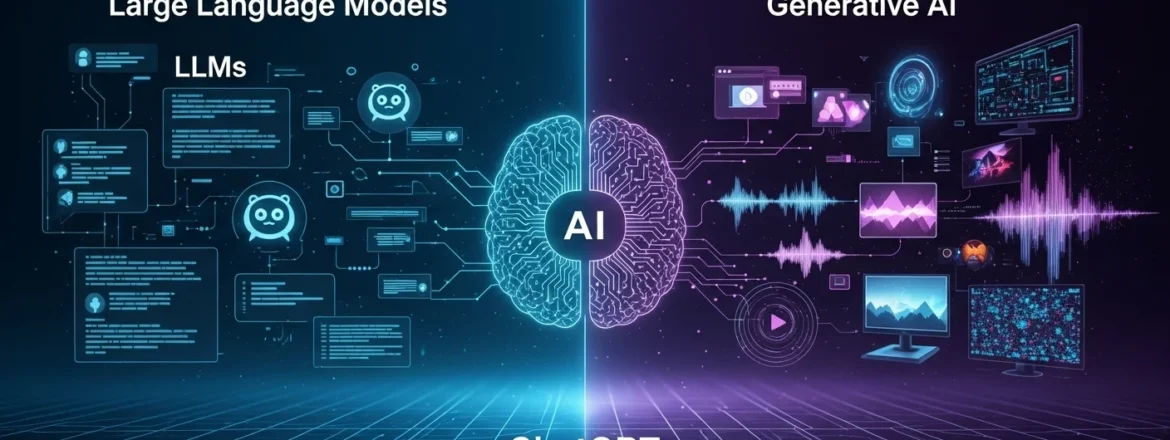
The rapid growth of artificial intelligence has left many professionals puzzled about where LLM vs Generative AI truly stand apart. You’ve probably heard both terms tossed around in conversations, articles, and tech updates, but the overlap often makes it hard to know what’s what. Are they the same thing? Do they serve different purposes? And more importantly, which one should businesses lean on when building smarter workflows?
This article clears the fog. We’ll break down the difference between LLM vs Generative AI in simple terms, explain how each one works, and show where they intersect. By the end, you’ll know exactly when an LLM fits your needs, and when tapping into the broader power of Generative AI makes more sense.
To make it crystal clear, we’ll walk through real-world examples, use cases, and future trends, so instead of confusion, you’ll have a practical guide that can actually shape smarter business decisions.
Table
Aspect | Large Language Models (LLMs) | Generative AI |
Main Focus | Text understanding & generation | Multi-format content (text, images, audio, video) |
Best For | Chatbots, SEO content, translation, automation | Visuals, video production, design, marketing, creative media |
Architecture | Transformer-based | Mix of transformers, GANs, diffusion, VAEs |
Resource Needs | Moderate | High (compute, storage, cost) |
Output Style | Human-like language | Creative, multimodal outputs |
Examples | GPT-4, Claude, LLaMA, BERT | DALL·E, MidJourney, Stable Diffusion, Runway |
Business Fit | Text-heavy workflows | Multimedia and creative industries |
What is Generative AI?
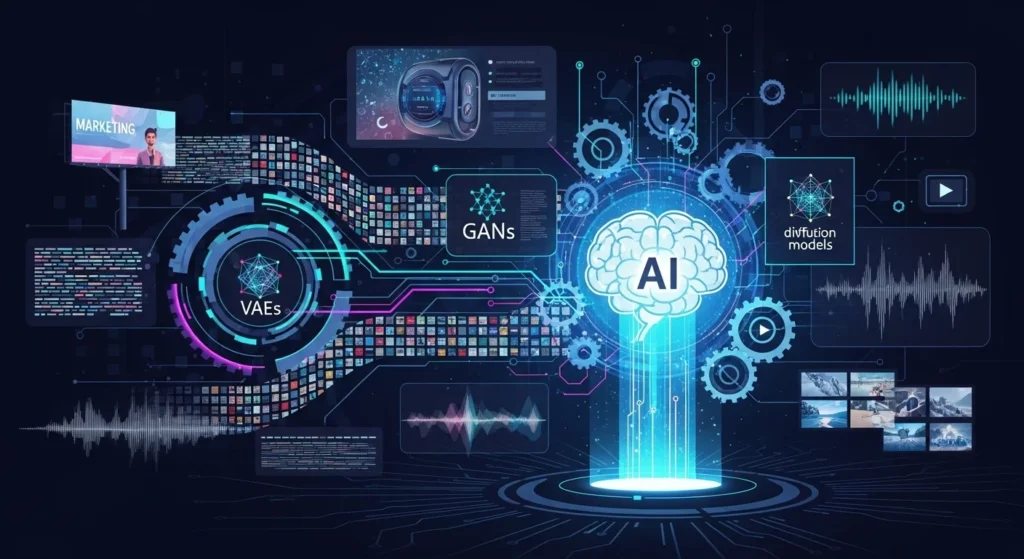
Generative AI is about creating new content, not just analyzing existing data. It powers text, images, audio, and even video, giving machines the ability to “imagine” outputs that feel fresh and useful. This same technology is transforming digital marketing through AI SEO, where search optimization becomes smarter and more data-driven. Tools like DALL·E or MidJourney, for example, can produce visuals from text prompts, while other systems generate lifelike voiceovers or even compose music.
The technology relies on several model architectures that go beyond language models. GANs (Generative Adversarial Networks) create realistic images by having two models compete against each other, diffusion models polish noisy data into sharp visuals, and VAEs (Variational Autoencoders) help machines learn new styles and variations. Each brings its own specialty, whether it’s sharper pictures, smoother transitions, or innovative outputs.
At the heart of this creativity is data. Generative AI thrives on massive datasets, millions of lines of text, billions of images, or endless audio clips. The more varied the data, the more versatile the results. That’s why businesses using generative AI can design marketing visuals, produce product mockups, or even build entire presentations in just a few minutes.
What are Large Language Models (LLMs)?
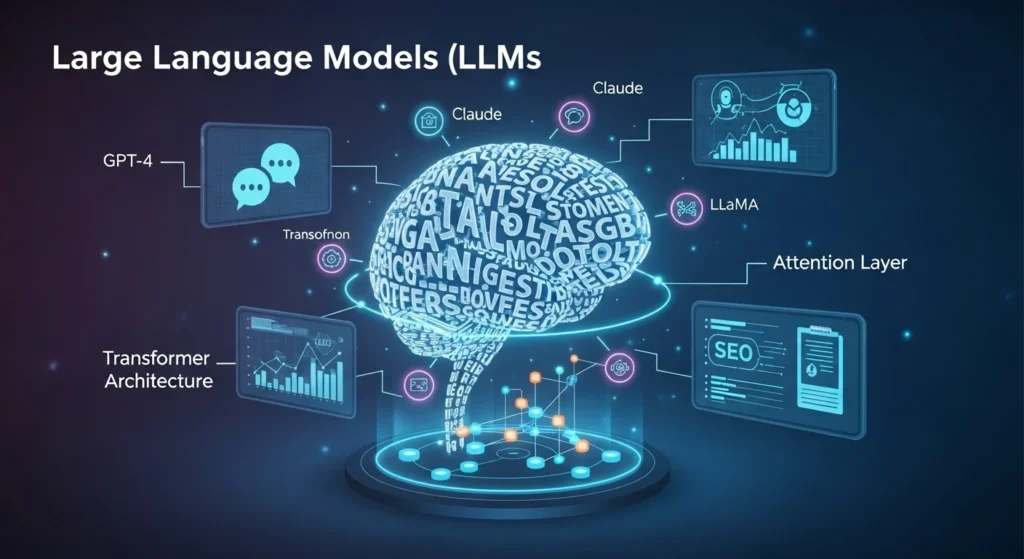
Large Language Models are currently the most widely recognized type of Generative AI, and for good reason. They focus primarily on language, reading, understanding, and producing text that feels natural and human-like. From answering customer queries to drafting reports, these models have transformed the way businesses interact with information.
At their core, LLMs are built on transformer architecture, a design that allows them to handle long sequences of text while maintaining context. Instead of simply guessing the next word, they analyze relationships between words and phrases, which results in far more accurate and coherent output.
Unlike broader generative AI systems that produce images, audio, or video, LLMs are text specialists. They excel at writing articles, generating summaries, translating between languages, or fueling customer service chatbots. This makes them especially valuable for businesses that rely heavily on communication, SEO-friendly content creation, and process automation.
Some well-known examples include GPT-4, celebrated for its conversational depth, Claude, recognized for its safety-first approach, LLaMA, widely used in research environments, and BERT, which has become a cornerstone for search optimization. Each model has its unique strengths, but together they highlight just how powerful and versatile LLMs have become in real-world applications.
Key Differences Between LLM and Generative AI
The line between them matters for strategy.
Scope & modalities: LLMs: text only. Generative AI: text, images, audio, video. That’s the biggest split.
Output & use cases: LLMs answer emails, generate reports, and support customers. Generative AI designs visuals, produces music, or builds full campaigns.
Architecture: LLMs = transformers. Generative AI = a mix (transformers, GANs, diffusion).
Cost & scaling: LLMs are generally lighter. Full generative AI stacks can require powerful GPUs, massive storage, and bigger budgets.
Why comparing LLM vs Generative AI matters now
With so much buzz, professionals need clarity. Should you invest in LLMs for customer interactions, or adopt full generative systems for visuals, audio, and text together? The right choice impacts budget, scalability, and ROI. Businesses in the USA, UK, Canada, and Australia are actively deciding where to focus, making this comparison more critical than ever.
Generative AI: What It Is & How It Works
Generative AI works by training on massive datasets, then predicting new outputs based on learned patterns.
Text, image, audio, video: Whether it’s writing ad copy, generating logos, composing jingles, or creating product videos, generative AI makes all this possible. This broad scope is what sets it apart from LLMs.
Beyond LLMs: Generative AI doesn’t stop at language. Models like diffusion handle visual detail, while GANs pit two networks against each other to sharpen realism. These approaches are why AI art and deepfakes look so convincing today.
Data & novelty: Generative systems aren’t copying, they’re recombining. They analyze patterns, then create something new, which feels both original and practical for industries like marketing, real estate, healthcare, and entertainment.
Real-World Use Cases
Both LLM and Generative AI are making a real impact in business today, but they shine in different ways. Let’s break down how each is applied in everyday scenarios.
Text-focused: Customer service chatbots, SEO content, email replies, legal drafting, LLMs already shine here.
Multimodal: Generative AI powers advertising visuals, product designs, voice assistants, and AI video production. Companies are using it for virtual real estate tours, healthcare imaging, and personalized marketing.
Choosing the right tool: If your main need is language, stick with LLMs in Machine Learning. If you need multimedia creativity, go with generative AI.
Challenges & Trade-Offs
While both LLM and Generative AI bring powerful advantages, they also come with hurdles that businesses must carefully manage. Here are the main issues to watch out for.
Accuracy & Bias: LLMs sometimes hallucinate facts, confidently generating information that isn’t true. On the other hand, generative AI can create misleading visuals or deepfakes, blurring the line between real and artificial. These risks highlight why human oversight is critical, AI should assist, not blindly replace, decision-making.
Resource Load: Running full generative AI systems often demands heavy computing power, large storage capacity, and costly infrastructure. For smaller companies, that means higher bills and slower scaling. LLMs, while still resource-intensive, tend to be lighter and cheaper to maintain, making them more practical for businesses starting out with AI.
Ethics & Privacy: AI doesn’t just generate content; it also raises ethical and compliance concerns. From biased training data that reinforces stereotypes to videos that could be used for harmful manipulation, both LLMs and generative AI need strong governance, transparent policies, and responsible usage guidelines. Protecting customer data and maintaining trust must remain top priorities for organizations deploying these tools.
Future Trends
The pace of innovation shows that both LLM and Generative AI are far from their peak. New developments are shaping how businesses and individuals will use these technologies in the coming years.
Multimodal Growth: We’re moving toward systems that can combine text, visuals, and audio in one seamless flow. Imagine asking a chatbot for a marketing campaign and instantly getting not just ad copy, but images, jingles, and video drafts in the same package. This trend will blur the boundaries between LLMs and generative AI even further.
Custom Models: Companies are no longer satisfied with one-size-fits-all AI. The rise of fine-tuned LLMs and domain-specific generative models means businesses can train AI on their own data. That way, hospitals get medical-focused models, while financial firms build compliance-aware assistants. This shift makes AI outputs more relevant and industry-ready.
Regulation: Governments are stepping in to address concerns around AI transparency, data safety, and responsible use. Expect stricter rules about what AI can generate, how training data is collected, and how businesses disclose AI-generated content. While regulation may slow unchecked experimentation, it also creates a safer, more trustworthy environment for long-term adoption.
FAQs
Is an LLM the same as Generative AI?
No. LLMs are a type of generative AI, but generative AI covers more than language.
Can a generative AI model work without LLM?
Yes. Image models or audio generators don’t always rely on language models.
What are the costs involved?
LLMs are generally cheaper. Generative AI can require heavy compute resources.
How secure are these tools?
Security depends on data handling, compliance, and provider safeguards.
Conclusion
LLM vs Generative AI isn’t about one winning, it’s about fit. LLMs excel in text-heavy workflows, while generative AI brings creativity across multiple formats. According to a detailed analysis by CSET on what differentiates generative AI, large language models, and foundation models, the overlap and distinctions become clear—and you’ll see that choosing the right tool is the real key.
If you’re ready to scale smarter, XtreemeTech helps businesses integrate both LLM vs Generative AI solutions, whether you need smarter chatbots, predictive analytics, or full multimedia automation. Start by asking: do you need sharper text workflows, or a full creative AI engine? From there, we’ll build the system that delivers ROI.