

September 17, 2025
- By: Atif Latest News /
AI in CRM: What Does AI Actually Do for a CRM?
CRM systems have been part of business workflows for years, yet many professionals still find themselves drowning in scattered data, slow follow-ups, and missed opportunities. The challenge isn’t in storing customer information, it’s in making sense of it quickly enough to act.
This is where AI in CRM steps in. By turning raw customer data into meaningful insights, automating repetitive tasks, and predicting future behavior, AI transforms a CRM from a simple record-keeping tool into a decision-making powerhouse. Businesses no longer need to guess which leads are worth pursuing or struggle with generic outreach campaigns, AI makes the entire process sharper, faster, and far more effective.
Companies like Salesforce, HubSpot, and Zoho are already proving that when AI features are integrated into CRM platforms, the results speak for themselves: higher conversions, stronger customer relationships, and measurable growth. At Xtreemetech, we bring the same approach to businesses of any size, helping them implement AI in CRM strategically so they can unlock these benefits faster, with solutions tailored to their specific goals.
Table
Use Case | How AI in CRM Helps | Business Impact |
Customer Support Automation | Chatbots handle FAQs, ticket routing, and live chat support. | Faster resolutions, higher satisfaction. |
Scalability for SMEs | AI adapts to small or large datasets and team sizes. | Affordable growth and efficiency. |
Data Security & Compliance | AI monitors threats, enforces data protection, and ensures GDPR/CCPA compliance. | Reduced risk, stronger trust. |
No-Code AI Features | Pre-built AI tools inside CRMs simplify adoption. | Saves time, easy onboarding. |
Cross-Tool Integration | AI connects CRM with marketing and sales platforms. | Unified customer view, smoother workflows. |
What is AI in CRM?
AI in CRM means embedding artificial intelligence into customer relationship management platforms to analyze data, predict customer behavior, and automate workflows. Instead of simply being a digital filing system, the CRM becomes an intelligent assistant that continuously learns from customer interactions.
For modern businesses, this shift matters because speed, personalization, and foresight now define competitive advantage. Whether you’re a small startup or an enterprise, AI in CRM enables smarter decision-making, faster responses, and deeper customer relationships.
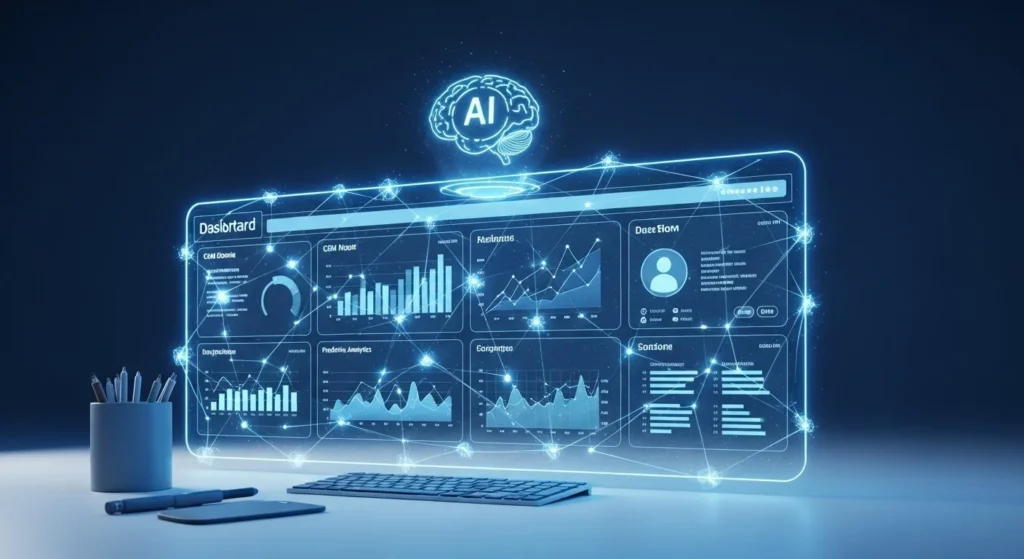
What Does AI Actually Do for a CRM?
CRM systems with AI bring multiple functions under one roof. Each capability saves time, increases accuracy, and makes customer management more strategic.
Improves Customer Insights: CRMs collect mountains of data, from purchase histories to support tickets. AI makes sense of it instantly. Instead of combing through spreadsheets, managers get real-time insights about customer preferences, pain points, and engagement patterns. For example, an AI-driven CRM might flag that a certain customer segment is more likely to purchase premium services during holiday campaigns.
Predicts Customer Behavior: One of the most powerful abilities of AI-powered systems is predicting what customers will do next. Lead scoring algorithms rank which prospects are most likely to convert, while churn models identify which clients may cancel or stop purchasing soon. This foresight allows teams to focus on the right opportunities and intervene before losing valuable customers.
Automates Repetitive Tasks: Sales and marketing teams often spend hours scheduling follow-ups, sending reminders, or updating records. AI removes this burden. Automated email triggers, intelligent reminders, and smart scheduling save time and keep pipelines moving without manual effort. The result: more time spent closing deals, less time on busywork.
Enhances Personalization: Generic marketing no longer works. AI enables hyper-personalized communication by analyzing customer data and tailoring offers, campaigns, and recommendations. For example, an online retailer can use AI to send personalized discounts based on browsing history, making outreach feel more relevant and boosting conversions.
Evolution of CRM to AI-Driven CRM
Traditional CRMs were built for storage and tracking. Modern AI-powered CRMs are built for learning and predicting. Machine learning allows systems to identify patterns in massive datasets. Predictive analytics highlights future opportunities and risks. Generative AI, much like tools such as ChatGPT, even helps draft personalized emails or suggest sales pitches. The shift isn’t just technological; it redefines how businesses engage with customers.
Top AI-Powered CRM Tools & Platforms
Several platforms are leading this transformation:
Salesforce Einstein: Advanced predictive analytics, natural language processing, and automation.
HubSpot CRM: AI-powered content suggestions, lead scoring, and conversation insights.
Zoho CRM: Predictive sales forecasting and conversational AI assistant “Zia.”
Freshworks CRM: AI for deal insights, activity capture, and personalized recommendations.
Benefits
Businesses investing in AI-powered CRMs are seeing tangible results:
Operational efficiency: Less time on manual data entry and admin.
Customer retention: Anticipating customer needs strengthens loyalty.
Sales growth: Smarter lead targeting boosts conversions.
Better decision-making: Leaders rely on data-backed insights rather than guesswork.

Challenges Without Expert Support
Many businesses adopt AI features but fail to unlock full value because they lack expertise. Common issues include:
Selecting the wrong AI tools.
Poor integration between CRM and other systems.
Data errors or bias skewing predictions.
- Missed ROI due to unclear strategy.
Why Businesses Need Expert-Led AI CRM Solutions
Implementing AI successfully requires technical knowledge, AI SEO, and business strategy. Expert-led solutions bring:
Customized integrations: Every CRM platform (Salesforce, HubSpot, Zoho, etc.) requires different handling.
Scalability: From startups to enterprises, AI features can grow as business needs expand.
Data security and compliance: Critical in regions with strict privacy regulations like the USA, UK, Canada, and Australia.
Maximized ROI: Professionals align AI features with goals to deliver measurable outcomes.
Challenges and Risks
Even with the right tools, challenges exist:
Data quality issues: Poor data leads to poor AI outputs.
User adoption: Teams may resist new technology.
Cost barriers: Advanced AI features can be expensive.
- Balancing automation with human touch: Over-automation risks losing authenticity in customer relationships.
Best Practices for Deploying AI in CRM
To get the best results, businesses should:
Define clear goals and KPIs for AI integration.
Keep CRM data clean and well-structured.
Choose AI features based on specific business needs, not trends.
Maintain a balance between automation and human interaction.
Future Trends
The future looks promising, with innovations already shaping the next generation of CRMs:
Real-time personalization at scale.
Smarter conversational agents that handle complex queries.
Integration with IoT, AR/VR, and voice assistants for immersive experiences.
Ethical and explainable AI ensures transparency and trust.
FAQs
Conclusion
How does AI improve customer support?
AI-driven systems use chatbots and natural language processing to provide instant responses, resolve common queries, and route complex issues to the right agents. This reduces response times and improves customer satisfaction.
Can AI tools in customer management help small businesses, or is it only for enterprises?
Yes, small businesses can benefit just as much as large enterprises. Scalable AI features such as automated follow-ups, lead prioritization, and personalized outreach make it easier for smaller teams to compete effectively without needing massive resources.
What role does AI play in CRM data security?
AI enhances CRM data security by detecting unusual activities, flagging suspicious login attempts, and helping businesses comply with regulations such as GDPR and CCPA.
Does using AI features in customer management require coding or technical expertise?
Not necessarily. Most modern CRM platforms include built-in AI tools that are easy to use. However, for advanced integrations and to get the highest ROI, expert customization is often recommended.
Does using AI features in customer management require coding or technical expertise?
Not necessarily. Most modern CRM platforms include built-in AI tools that are easy to use. However, for advanced integrations and to get the highest ROI, expert customization is often recommended.
AI in CRM is no longer optional, it’s the difference between businesses that grow and those that lag. It helps companies see patterns, predict outcomes, and connect with customers in meaningful ways. But tools alone aren’t enough; success comes from using them strategically.
Technology alone doesn’t create success, it’s the way it’s applied that makes the difference. Our agency helps businesses unlock the full potential of their customer data through intelligent integration, predictive analytics, and smart automation. If you’re ready to transform your CRM into a true growth engine, let’s talk.