
What Is a Vibe Code Cleanup Specialist?
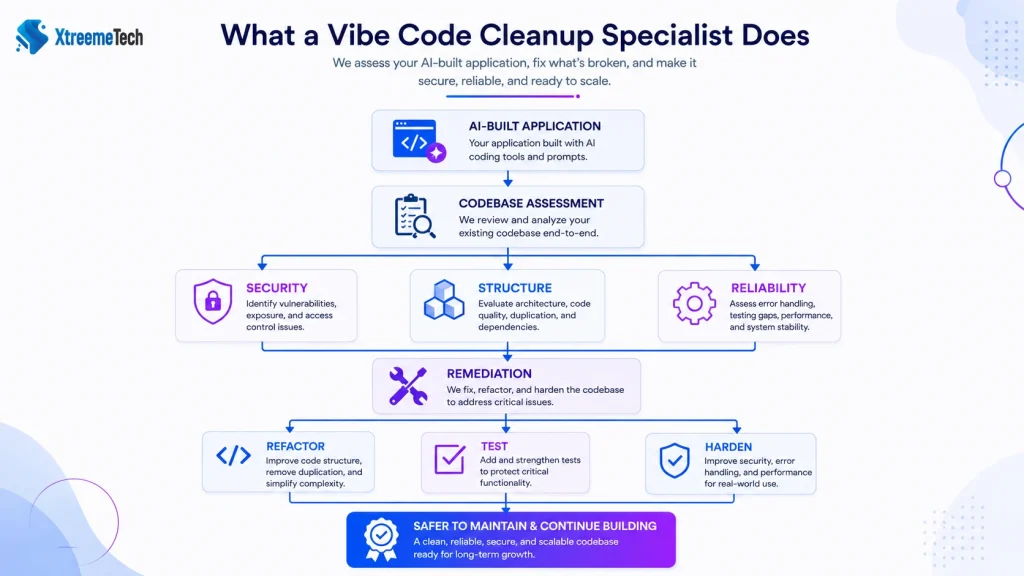
A vibe code cleanup specialist is a software engineer who assesses and improves applications built substantially with AI coding tools. They examine the existing codebase, identify technical and security risks, repair or restructure areas that need attention, and determine whether the application is ready for its next stage of development.
The role becomes relevant when a project moves beyond the initial prototype. An AI coding tool can help produce a working feature in minutes, but a growing application also needs coherent architecture, reliable error handling, appropriate security controls, testing, and a codebase that another developer can understand.
That creates an important distinction: a working AI-built application can still need engineering work before it is ready for sustained development or production use.
What Is Vibe Code Cleanup?
Vibe code cleanup is the process of reviewing and improving an existing AI-generated codebase so it becomes more reliable, maintainable, and easier to develop further.
Depending on the project, the work can involve:
- reviewing the application’s architecture
- identifying duplicated or inconsistent logic
- correcting fragile implementations
- improving error handling
- addressing security weaknesses
- strengthening tests around critical functionality
- simplifying dependencies and unnecessarily complex code
- improving maintainability and reliability
The emphasis is on the condition of the software, rather than its appearance. Reformatting files or reorganizing folders may be useful along the way, but the meaningful outcome is a system that can be understood, tested, modified, and operated with greater confidence.
Why Can Vibe-Coded Apps Need Cleanup?
AI coding changes the economics of software development. A founder or small team can describe a feature, review the generated result, make another request, and continue building without manually writing every component.
That speed is useful. It also changes how the codebase develops.
Imagine an application that has gone through dozens of iterations: authentication was added in one session, payments in another, a dashboard later, followed by several rounds of bug fixes and feature changes. Each request may have produced a reasonable local solution, while the combined system gradually accumulated different patterns, duplicated logic, unnecessary dependencies, or assumptions that no longer fit the application as a whole.
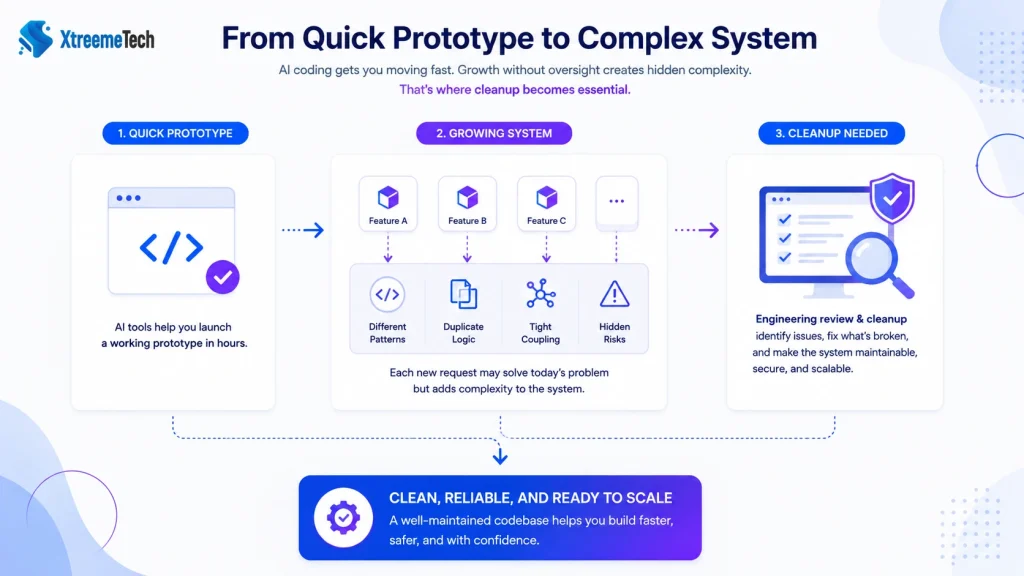
The underlying issue is system-level consistency. Individual AI-generated changes can be functional while the larger codebase becomes harder to reason about.
Research supports the distinction
A 2025 study examined 4,442 Java assignments generated by five large language models and found bugs, security vulnerabilities, and code smells across the generated code. The researchers also found that functional test performance did not reliably predict overall code quality and security. In other words, passing a functional test was not enough to establish that the generated code was sound.
Another benchmark looked specifically at security in AI-agent-generated software. Across 200 real-world software-engineering tasks, the evaluated SWE-Agent/Claude 4 Sonnet combination produced functionally correct solutions in 61% of cases but secure solutions in only 10.5%.
These studies don’t establish that AI-generated software is inherently poor. They demonstrate a narrower and more useful point for anyone maintaining an AI-built application:
Functionality is only one dimension of software quality.
A feature can work while the surrounding system still contains security, architectural, maintainability, or reliability problems.
What Does Research Say About Security in Vibe-Coded Applications?
Security deserves particular attention because AI agents can generate large portions of an application’s implementation without the developer manually reviewing every decision.
A June 2026 study, Understanding the (In)Security of Vibe-Coded Applications, examined real-world applications developed with popular AI agents. The researchers identified recurring vulnerability patterns including placeholder logic, unfiltered input, and secret exposure. They also identified limitations in AI-agent workflows, including loss of context between interactions and locally optimized objectives.
This matters because security defects frequently remain invisible during normal use.
A login can appear to work while authorization rules are incomplete. An API can return the expected response while exposing more data than the requesting user should receive. An application can process customer information correctly while storing credentials or secrets in an unsafe location.
That is why an engineering review needs to consider more than the visible behavior of the product. The relevant questions include:
- Who can access this data?
- What happens when input is manipulated?
- Are secrets protected?
- Are database permissions appropriate?
- What happens when an external service fails?
- Can an unexpected request bypass an intended control?
For an application that handles accounts, payments, business data, or other sensitive information, these questions become part of determining whether the codebase is ready for real-world use.
What Problems Can a Vibe Code Cleanup Specialist Find?
The exact findings depend on the application, but several categories appear frequently during codebase reviews.
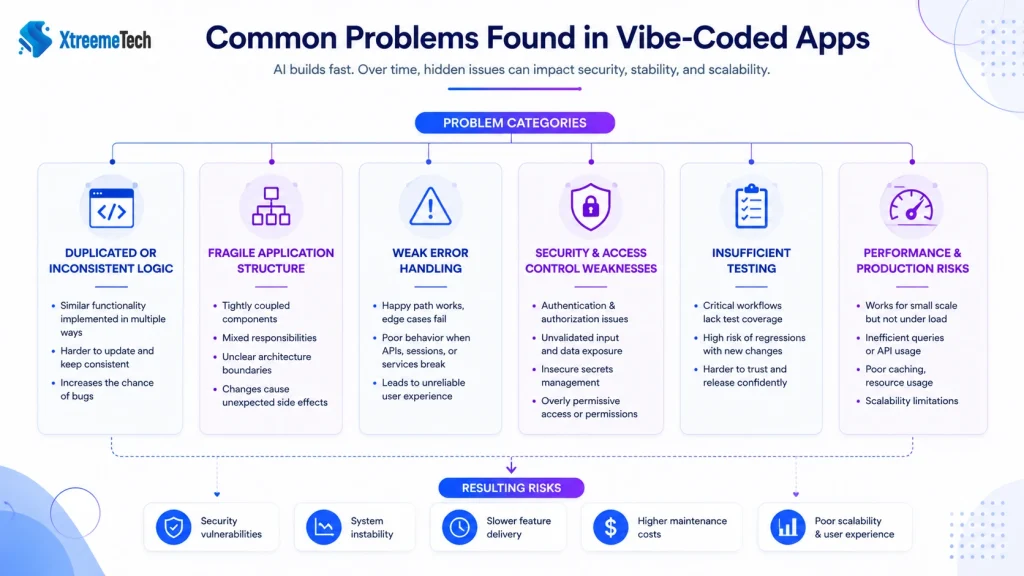
Duplicated or inconsistent logic
Different features can contain separate implementations of similar functionality. That creates maintenance problems because a change made in one location may leave another implementation untouched.
Fragile architecture
As features accumulate, responsibilities can become mixed together and dependencies can become tightly coupled. The result is often a system where relatively small changes have unexpected side effects.
Weak error handling
Prototype development tends to demonstrate the successful path first. Production software also needs predictable behavior when an API fails, a session expires, data is invalid, a database operation times out, or an external service becomes unavailable.
Security and access-control weaknesses
Depending on the project, a review may examine authentication, authorization, input validation, API permissions, database access, secrets, and dependency security.
Testing gaps
Critical workflows may have little automated coverage, making subsequent changes harder to validate. This becomes particularly important when the application continues to evolve through AI-assisted development.
Performance and production concerns
An application can behave perfectly with a small dataset and limited traffic while encountering problems as usage increases. Database queries, API calls, resource consumption, caching, and application architecture can all become relevant.
These findings don’t automatically mean the entire application needs to be replaced. They establish what needs attention and how serious the situation is.
What Does a Vibe Code Cleanup Specialist Actually Do?
A useful cleanup engagement starts by understanding the system before making substantial changes.
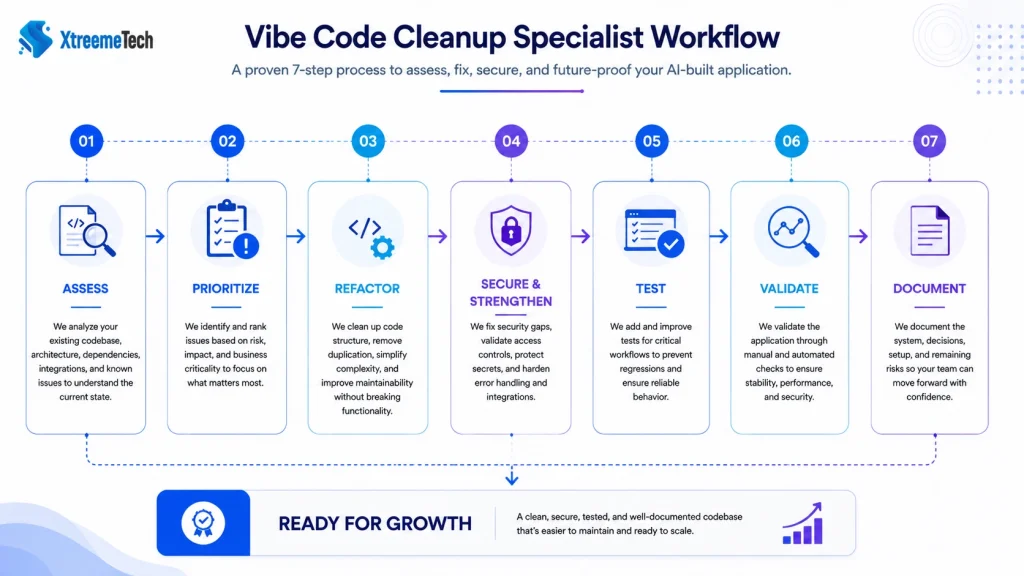
1. Assess the existing application
The first step is to establish how the application currently works.
A review can cover the frontend and backend structure, database, APIs and integrations, authentication, dependencies, deployment configuration, and known failure points.
This creates a baseline for deciding what should change and what should remain untouched.
2. Prioritize the risks
A codebase can contain hundreds of imperfections without all of them deserving immediate remediation.
Security exposure, data-integrity problems, recurring production failures, and architectural issues that prevent further development generally take precedence over minor technical debt or cosmetic improvements.
This prioritization is one of the more important parts of the work. The goal is to improve the application’s risk profile and maintainability, not to create a perfect codebase on paper.
3. Refactor the areas worth keeping
Where the foundation is sound, the specialist can consolidate duplicated logic, separate responsibilities, simplify dependencies, and establish clearer boundaries between components or modules.
The emphasis is controlled improvement rather than rewriting functioning software simply because another implementation style is preferred.
4. Address security and reliability issues
Findings from the assessment can lead to changes involving authentication, authorization, input validation, API access, database permissions, credentials, dependencies, or failure handling.
The exact scope depends on what the application actually does and what risks it carries.
5. Protect critical functionality with tests
Testing should focus on behavior that matters to the product.
That may include authentication, payments, important database operations, core user workflows, third-party integrations, and areas that have previously caused regressions.
The purpose is to create confidence that future changes can be made without repeatedly rediscovering the same problems.
Research into LLM-generated code reinforces the value of looking beyond functional correctness. A 2025 quality-assurance study examined non-functional characteristics such as security, maintainability, and performance and highlighted the limitations of evaluating generated code solely through functional success.
6. Validate the result
After remediation, the application needs to be checked again.
Depending on its purpose and risk profile, that can involve regression, integration, end-to-end, security, or performance testing.
7. Document the system
The final codebase should be easier for another engineer to understand. Useful documentation can cover setup, architecture, deployment, important dependencies, significant technical decisions, and known limitations.
That creates continuity beyond the person who performed the cleanup.
When Do You Actually Need a Vibe Code Cleanup Specialist?
The fact that an application was built with AI isn’t, by itself, a reason to hire someone.
The stronger signal is that the state of the codebase is beginning to constrain what you can safely do next.
You may want an assessment when:
- the MVP works, but you’re increasingly afraid to modify it
- fixing one feature repeatedly breaks another
- nobody has a clear picture of how the system is structured
- you’re preparing to launch and the underlying code hasn’t been reviewed
- the application now handles real customer or sensitive data
- you’ve inherited an AI-generated application from another developer
- adding features has become disproportionately difficult
- performance or reliability has deteriorated
- you’re unsure whether the current foundation is safe to keep building on
There is also an important distinction between a codebase that needs cleanup and an application that is already broken.
If the software is failing and you need to diagnose, repair, and stabilize it, the problem moves into broader app rescue territory. Our guide on how to fix a broken vibe-coded app covers that recovery process in more detail.
Vibe Code Cleanup vs. Rebuilding the Application
A cleanup makes sense when there is enough of a sound foundation to preserve.
That may mean the core workflows work, the architecture can be corrected without replacing everything, and existing data or integrations would be expensive or risky to recreate.
A rebuild becomes more attractive when fundamental architectural decisions are creating problems throughout the system, critical issues are deeply embedded, or continued remediation would approach the cost and risk of starting again.
The practical question is therefore:
How much of the existing application is worth keeping?
That answer should come from examining the codebase, architecture, dependencies, security, functionality, and future requirements—not from judging how untidy the source files look.
For the detailed decision framework, see how to decide whether to fix or rebuild an AI app.
What Should a Proper Vibe Code Cleanup Deliver?
A useful engagement should leave the application in a better position for its next stage.
Depending on the project, that can include:
- a documented assessment
- prioritized technical issues
- critical problems resolved
- improved code structure
- security weaknesses addressed
- tests around important workflows
- stronger error handling
- production or deployment improvements where required
- clearer documentation
- an explanation of remaining technical risks
The practical measure of success is whether the team can now work on the application with greater confidence.
That might mean adding features without repeatedly breaking existing ones, understanding where changes belong, knowing which risks remain, and having enough testing and documentation to support continued development.
How Platform-Specific AI App Problems Fit In
The same engineering principles apply across applications created with Lovable, Bolt, Replit, Claude Code, Cursor, and other AI development environments. The actual problems, however, depend on the resulting stack and how the project was developed.
A Lovable project may have a different failure pattern from a Replit application developed alongside Claude Code. That makes platform-specific diagnosis useful when the problem is tied to a particular environment.
If that’s the situation, these guides go deeper without duplicating their content here:
Where Does Vibe Code Cleanup Fit Into AI App Rescue?
Cleanup is one possible component of a broader AI app rescue process.
A project might begin as a working prototype and later develop bugs, security concerns, deployment failures, architectural problems, or other issues that prevent its owner from moving forward confidently. An assessment can then determine whether the right response is targeted cleanup, debugging, stabilization, or a partial or complete rebuild.
The distinction is useful:
Cleanup focuses on improving the existing codebase.
Rescue covers the broader process of understanding what has gone wrong and determining how to get the application back onto a viable path.
The scope varies considerably between projects. A small MVP with duplicated logic is very different from a customer-facing system with authentication, payments, databases, third-party integrations, and sensitive information.
If you’re assessing the financial side of remediation, our guide covers how much it costs to fix a vibe-coded app.
If the application already has bugs, security concerns, deployment problems, or structural issues that are preventing progress, Xtreme Tech’s AI App Rescue Service can assess the existing system and determine the appropriate path forward.
Final Takeaway
A vibe code cleanup specialist brings software-engineering judgment to an application that has been built or substantially accelerated with AI.
Their work starts with understanding the existing system, identifying meaningful risks, and deciding what should be preserved, repaired, refactored, tested, or replaced.
The research around AI-generated software makes that review increasingly relevant. Studies have found security vulnerabilities, bugs, code smells, and non-functional quality problems that aren’t necessarily visible when generated code simply passes a functional test.
That doesn’t mean every AI-built project needs professional intervention.
It means the requirements change as the software moves from prototype to real users, real data, and production.
At that point, the useful question is no longer just:
“Does the app work?”
It’s:
“Can we safely maintain and evolve what we’ve built?”
For some projects, the answer is a straightforward cleanup. For others, it may lead to deeper stabilization or a rebuild.
That’s the role a vibe code cleanup specialist helps determine.