
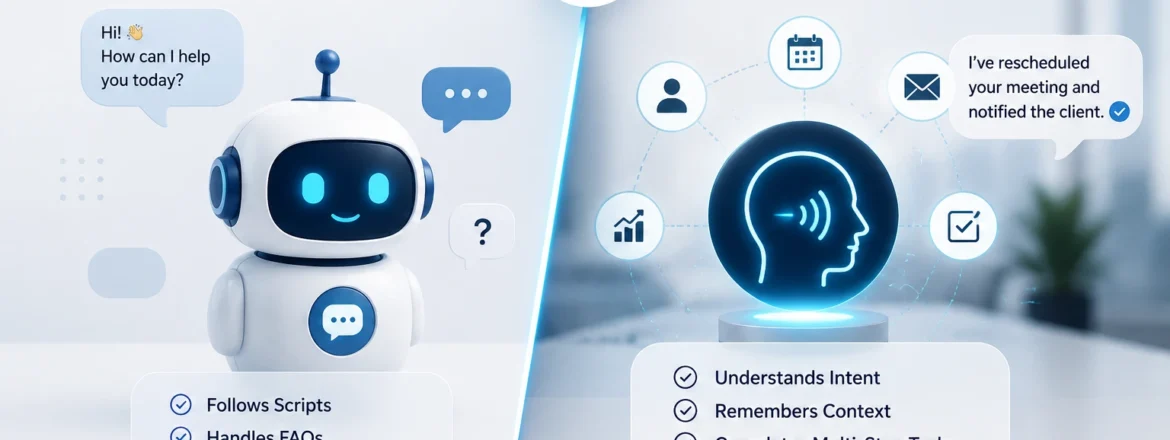
Chatbot vs. Virtual Assistant: What’s the Actual Difference?
A chatbot answers questions and follows scripts. A virtual assistant understands intent, holds context across a conversation, and can complete multi-step tasks on your behalf. That’s the core distinction but in practice, the terms get used interchangeably so often that most people asking this question aren’t sure which one they actually need, or which one a given tool really is. At Xtreeme Tech, we have built both chatbot and virtual assistant integrations for clients, which means this isn’t a vendor pitch for one over the other. It’s a practitioner’s plain answer to what each one actually does.
What Is a Chatbot?
A chatbot is a conversational tool built to handle a narrow, defined set of tasks answering FAQs, routing a support query, walking someone through a simple process like booking an appointment. It works from a fixed scope: either following scripted decision trees, or using natural language processing to understand a request within that scope, but not much beyond it.
Chatbots don’t generally carry context between unrelated questions. Ask one about your order status, then ask a follow-up that assumes it remembers the order; it may not connect the two unless it was specifically built to hold that context. That’s not a flaw; it’s the trade-off that makes chatbots fast, cheap to build, and reliable for high-volume, repetitive interactions like customer support and lead capture.
Where chatbots show up: website chat widgets, WhatsApp/Messenger business accounts, FAQ automation, appointment booking flows, order tracking.
What Is a Virtual Assistant?
A virtual assistant is built to understand intent, not just match keywords, and to carry that understanding across a longer, more open-ended interaction. It can hold context from earlier in the conversation, handle multi-step requests, and in more advanced implementations, take real actions across connected systems pulling data from a CRM, updating a calendar, triggering a workflow rather than just answering a question about them.
The practical difference shows up when the request gets complicated. A chatbot handling “what are your hours” is doing exactly what it’s built for. A virtual assistant handling “reschedule my Thursday appointment to next week and let the client know” is coordinating multiple steps and systems, which requires the broader reasoning and integration capability a scripted chatbot doesn’t have.
Where virtual assistants show up: voice assistants like Siri and Alexa, enterprise workplace assistants integrated into Slack or internal tools, and more advanced customer-facing assistants that go beyond FAQs into actually completing tasks.
Chatbot vs. Digital Assistant vs. Intelligent Virtual Assistant vs. AI Agent: All 6 Terms Compared
These six terms get used almost interchangeably in marketing material, which is exactly why the confusion persists. They’re not the same thing; each sits at a different point on a spectrum from “follows a script” to “acts independently toward a goal.”
| Term | How It Works | Best For | Example |
| Chatbot | Follows scripts or decision trees; matches keywords or intent within a narrow, predefined scope | High-volume, repetitive interactions, FAQs, order tracking, appointment booking | A website chat widget answering “what are your hours” |
| Virtual Assistant | Understands intent, holds context across a conversation, completes tasks reactively when asked | Multi-step personal or business tasks scheduling, reminders, retrieving information | Siri setting a reminder or answering a voice query |
| Intelligent Virtual Assistant (IVA) | An advanced chatbot layer understands context, learns from past interactions, handles more complex and personalized requests than a basic chatbot | Contact centers and support operations that need more than scripted FAQs but less than full task automation | A support IVA that recalls your account history mid-conversation |
| Conversational AI | The underlying technology category (NLP, NLU, ML) that powers chatbots, virtual assistants, and IVAs not a product itself, but the tech layer beneath all of them | Understanding this term helps when evaluating how a tool works, not choosing between products | The NLP engine inside a chatbot or virtual assistant |
| Digital Assistant | Often used interchangeably with “virtual assistant,” but leans toward broader, cross-system task execution think workplace productivity rather than a single chat window | Workplace tools integrated across calendar, email, and internal systems | A digital assistant scheduling a meeting across multiple people’s calendars |
| AI Agent | Acts autonomously toward a goal, with minimal ongoing human input doesn’t just respond to a request, it decides how to pursue an objective | Complex, multi-step business processes that would otherwise require ongoing human judgment | An agent that monitors inventory and automatically reorders stock when it runs low |
The short version: chatbots follow scripts, virtual assistants and digital assistants follow instructions with more flexibility, IVAs are a more advanced evolution of the chatbot layer, conversational AI is the technology underneath all of them, and AI agents are the only category on this list that acts without being asked each time.
Are Chatbots and Virtual Assistants the Same Thing?
No, though the confusion is understandable, since the two terms get used interchangeably in a lot of marketing material. A chatbot is built for narrow, scripted interactions. A virtual assistant is built to understand intent and complete broader, multi-step tasks. They’re related; a virtual assistant is often built using the same underlying conversational AI technology as a chatbot but they’re designed to solve different problems.
The overlap happens because the line has blurred as chatbots got smarter. A basic rule-based chatbot and an advanced AI-powered virtual assistant look similar on the surface both show up in a chat window and respond to text. What separates them is what happens when the request gets complicated: a chatbot without the underlying architecture of a virtual assistant will hit its limit fast, while a virtual assistant is specifically built to handle that complexity.
If a tool can only answer questions within a fixed set of topics and doesn’t remember earlier parts of the conversation, it’s a chatbot, regardless of what it’s marketed as. If it holds context, adapts to what you’re actually asking, and can complete a task rather than just describe how to do it, it’s functioning as a virtual assistant.
Which One Handles Complex, Multi-Step Requests?
Virtual assistants handle multi-step requests; chatbots generally don’t and the reason comes down to how each one processes what you’re asking.
A chatbot evaluates a request against a fixed set of intents or scripted paths. Ask it to do one thing within that scope, and it works well. Ask it to do something that spans multiple steps or depends on information from earlier in the conversation, and it typically breaks down either it can’t complete the second part, or it loses track of what the first part was about.
A virtual assistant is built to hold that context and coordinate across steps. The practical difference shows up in requests like these:
- Single-step, chatbot-appropriate: “What time do you close on Saturdays?”
- Multi-step, needs a virtual assistant: “Move my 3pm appointment to Thursday and send the client a confirmation.”
The second example requires understanding two related actions, checking availability, executing a change, and triggering a follow-up message all from one request. A chatbot built only for FAQ-style interactions has no mechanism to do that; it wasn’t built with the integrations or reasoning to coordinate across a calendar and a messaging system.
This is also where AI agents extend even further than virtual assistants: a virtual assistant completes multi-step tasks when asked, while an AI agent can pursue an ongoing goal without being prompted for each step like continuously monitoring a process and acting on its own when a condition is met.
For most small businesses, the practical question isn’t “which is more advanced”, it’s whether your actual use case involves single, repeatable requests (chatbot territory) or coordinated, multi-step tasks (virtual assistant territory).
Which One Does Your Business Actually Need?
Most small businesses starting out don’t need a virtual assistant, they need a well-built chatbot, and a lot of the confusion in this space comes from being sold more sophistication than the actual use case requires.
A chatbot is usually the right call if:
- Most of your customer interactions are repetitive hours, pricing, order status, booking a call
- You want fast deployment and lower cost to get started
- The goal is deflecting common questions away from your team, not automating complex workflows
A virtual assistant is worth the added complexity if:
- Your use case genuinely involves multi-step coordination scheduling across systems, personalized recommendations based on history, tasks that span more than one exchange
- You’re integrating across multiple tools (CRM, calendar, internal databases) and want one interface to manage them
- The interactions are varied enough that a fixed set of scripted paths won’t cover what customers actually ask
The honest answer, from having built both: a lot of businesses ask for a virtual assistant when a well-scoped chatbot would solve their actual problem for a fraction of the cost and complexity. The reverse is also true: some businesses under-scope the project with a basic chatbot when their real use case (multi-step booking, personalized account handling) needs the broader capability a virtual assistant provides. Getting this right at the start avoids paying for capability you don’t need, or hitting a wall six months in with something that was undersized from day one.
If you’re specifically weighing a custom-built option against an off-the-shelf tool, that’s a separate decision covered in our custom vs. off-the-shelf AI chatbot guide. And if the tool you already have was AI-built and isn’t working the way it should, that’s a different problem see our guide on AI app rescue and repair.
FAQs
What is the difference between a chatbot and a virtual assistant?
A chatbot follows scripts or decision trees to handle a narrow set of repetitive tasks, like answering FAQs or booking a simple appointment. A virtual assistant understands intent, holds context across a conversation, and can complete multi-step tasks checking a calendar, updating a record, and sending a confirmation, all from one request.
Are chatbots and virtual assistants the same thing?
No. They’re related, often built on similar underlying technology but a chatbot is designed for scripted, single-step interactions, while a virtual assistant is designed to handle broader, context-aware, multi-step requests.
What is the difference between a chatbot and a digital assistant?
“Digital assistant” is often used interchangeably with “virtual assistant,” but tends to describe tools focused on workplace productivity and cross-system task execution like scheduling across calendars or pulling data from internal tools rather than a single chat-window interaction, which is what a chatbot typically is.
What is the difference between a chatbot and an intelligent virtual assistant (IVA)?
An IVA is a more advanced evolution of the chatbot: it understands context, learns from past interactions, and handles more complex, personalized requests than a basic scripted chatbot, but it doesn’t necessarily have the full task-execution range of a virtual assistant or AI agent.
Can a business use a chatbot and a virtual assistant together?
Yes, and many do. A common setup uses a chatbot to handle high-volume, repetitive front-line questions, while a virtual assistant handles the more complex requests that get escalated past what the chatbot can resolve. They’re not mutually exclusive they solve different parts of the same problem.